
Upcoming Launch of the Strategic Hub for Interventions to Promote Early Detection and Lifelong Protection from Advanced RHD (SHIELD) SFRN
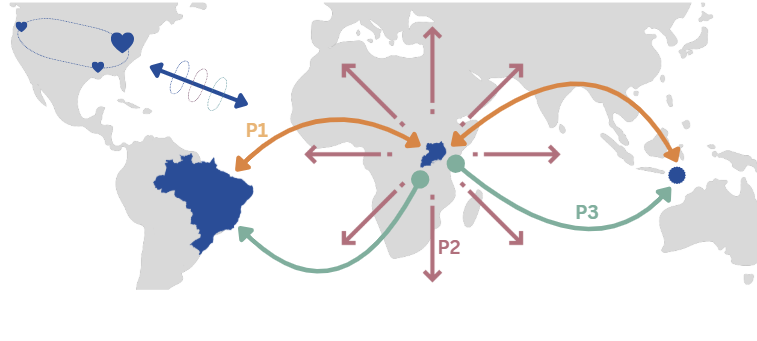
With Uganda as a center of excellence, SHEILD’s three international projects (P1-3) include investigators and teams working across project sites in Brazil, Timor Leste, and the United States.
We are excited to announce the launch of SHIELD, a new research network supported by the American Heart Association (AHA). SHIELD brings together a diverse, multidisciplinary group of researchers, clinicians, and implementation experts united by a shared goal: improving early detection of rheumatic heart disease (RHD) and preventing disease progression worldwide.
RHD remains a major cause of preventable illness and death in low‑resource settings, often diagnosed too late- after irreversible heart damage has already occurred.
A Collaborative Network with a Global Vision
Over the next four years, SHIELD partners will collaborate across interconnected projects to develop, test, and scale approaches that can be embedded into real‑world health systems. The network connects investigators and implementation partners across Uganda, Brazil, Timor‑Leste, and the United States, ensuring that solutions are not only innovative, but practical, adaptable, and responsive to local contexts.
Just as importantly, SHIELD brings together experienced leaders and early‑career investigators, working side by side to advance science, strengthen systems, and build lasting capacity for global RHD research.
SHIELD’s work is organized around three complementary research projects that span the RHD care continuum—from detection to treatment to long‑term protection. Together, these projects create a unified, end‑to‑end approach to RHD prevention.
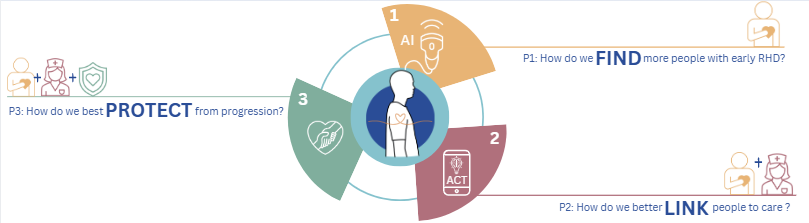
Project 1: Scaling Up Early Detection with AI
Project 1 focuses on accelerating early RHD diagnosis using AI‑assisted echocardiography. This project aims to:
Evaluate whether an AI‑powered echocardiography tool (named ‘RADAR’) improves diagnostic and implementation performance in Uganda based RHD screening.
Assess RADAR’s adaptability and implementation in Brazil and Timor Leste to support a scalable, long-term global model for RHD screening.
By enhancing frontline diagnostic capacity, this work aims to identify disease before symptoms appear.
Project 2: Linking Diagnosis to Lifesaving Care
Early diagnosis only matters if it leads to timely, effective care. Project 2 focuses on strengthening linkage to treatment and care continuity. This project aims to:
Develop and test ACT Registry tools within Uganda’s ADUNU program to improve linkage to care and treatment while assessing how practical, acceptable, and consistent the tools are in real‑world use.
Expand ACT globally (ACT‑Global), establish a RHD Quality Improvement Network and evaluate implementation across diverse health systems.
See here for more information
This work bridges the gap between detection and care- one of the most critical bottlenecks in RHD control.
Project 3: Supporting Adherence to Prevent Disease Progression
Long‑term prophylaxis is essential to prevent RHD progression, yet adherence can be challenging. Project 3 aims to:
Use human‑centered design and ADAPT guidance to tailor enhanced adherence supports for children with RHD in Brazil and Timor‑Leste.
Test the effectiveness and implementation of these supports, evaluating adherence as well as how acceptable, feasible, and consistently delivered they are.
Building the Next Generation of Global RHD Leaders
A defining feature of SHIELD is its deep commitment to mentorship, training, and research capacity building. The network is designed not only to generate evidence, but to grow a skilled, diverse global workforce equipped to lead future RHD efforts.
SHIELD will support four tiers of education and training:
Short courses to build foundational skills
Undergraduate fellowships to spark early interest in global heart health
Focused clinical research experiences for hands‑on learning
Two‑year postgraduate fellowships to develop independent investigators